
Quick answer: Dx-Chart vs Unified Practice is a question of scope. Dx-Chart is built for the chart: structured TCM fields, HPI drafts you request and review, and medical necessity reports from visits you pick. It does not offer scheduling or intake forms to clinics. Unified Practice's site describes one platform that joins charting with scheduling and billing1.
When Unified Practice is the better pick
Unified Practice presents itself as EHR and practice management software for acupuncture clinics1. Its pages list these tools:
- Scheduling. Online booking through one shared calendar for practitioners and rooms4.
- Patient portal. Patients can book visits and fill in digital intake forms before appointments2. They can also view invoices and pay there2.
- Billing. Insurance billing with HCFA/CMS-1500 forms, plus one-click superbills3. The same page says you can follow unpaid claims and balances3.
- Payments. Card payments during booking and cards saved on file5.
- Communication. Telemedicine video calls6. Text messaging and email reminders sit on the same page, along with secure fax6.
- Charting. TCM-specific charting with SOAP note layouts and licensed reference data built in7. Its features page adds a database of points and herbal formulas8.
- Plans and reports. Inventory management and telehealth appointments appear on its plan lists1. Its reporting page lists ready-made reports on finances and insurance billing9.
So the honest test is simple: list the front-desk jobs you need, then check each one against both products.
Booking is on Unified Practice's pages4, and Dx-Chart does not offer appointment scheduling to clinics. Unified Practice's portal takes digital intake forms2, and Dx-Chart does not offer patient intake forms to clinics. Unified Practice's pages list text and email reminders6. Dx-Chart does not email or text patients.
Using Dx-Chart alongside Unified Practice
Using both means each system keeps its job, with Unified Practice's pages listing scheduling and billing tools beside its own charting8. A few plain steps keep two systems straight:
- Pick one system to hold the signed chart for each visit, then write that rule down so everyone on your team charts in the same place.
- Chart every visit for that patient in Dx-Chart. A follow-up chart starts as a copy of the patient's most recent chart, codes included.
- Download the signed chart as a letter-size PDF when you need a copy outside Dx-Chart.
Moving from Unified Practice to Dx-Chart
Moving is mostly a records question. Unified Practice's HIPAA page mentions exporting data while signed in to your account10. Get the details in writing before you switch:
- Ask Unified Practice for a full export of your patient records, and ask which file formats it uses.
- Ask how long you can still sign in and download records after you cancel.
- Store the export safely, with the date you received it.
Ask Dx-Chart the same questions. Here are its answers:
- Charts download as letter-size PDFs. A patient's complete record exports as JSON or as a ZIP that adds their uploaded files.
- Canceling a subscription never deletes data. Terminating the account is a separate step by the clinic's owner admin.
- Termination opens a 90-day window to download a full clinic archive. The archive holds JSON records and uploaded files plus a CSV copy of the audit log. After that deadline, a daily job permanently destroys the clinic's data.
How does Dx-Chart build a Medical Necessity Report?
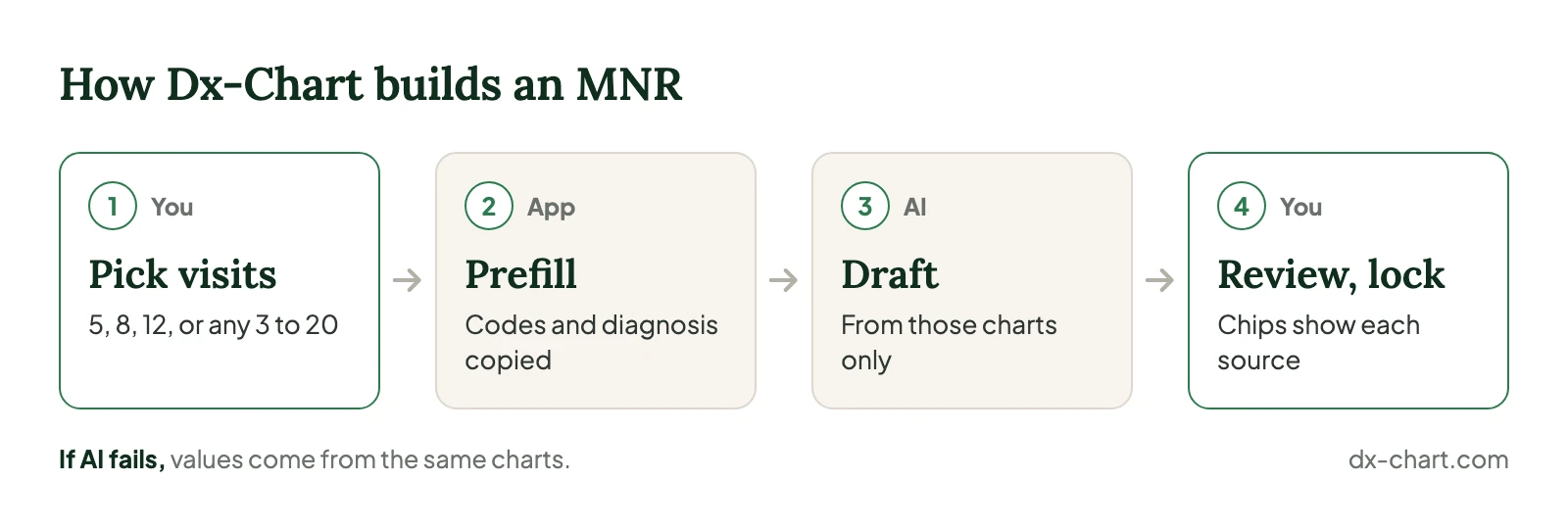
A Medical Necessity Report (MNR) is built from consecutive finalized visits you select.
Most acupuncturists have to send a medical necessity report after 5 visits, so it comes due on the 6th visit. The chart picker starts at 5 charts. Some acupuncturists may go 8 visits, and very rarely 12, so those are quick presets too. A custom count from 3 to 20 also works.
App logic prefills the report from the charts you picked. AI receives only those charts. It rates each condition with a short rationale and drafts the treatment-plan response across all selected visits. It fills pain location only when no selected chart records one.
If AI generation fails, the report falls back to values taken from the same charts. You edit the draft before you complete it.
Evidence chips
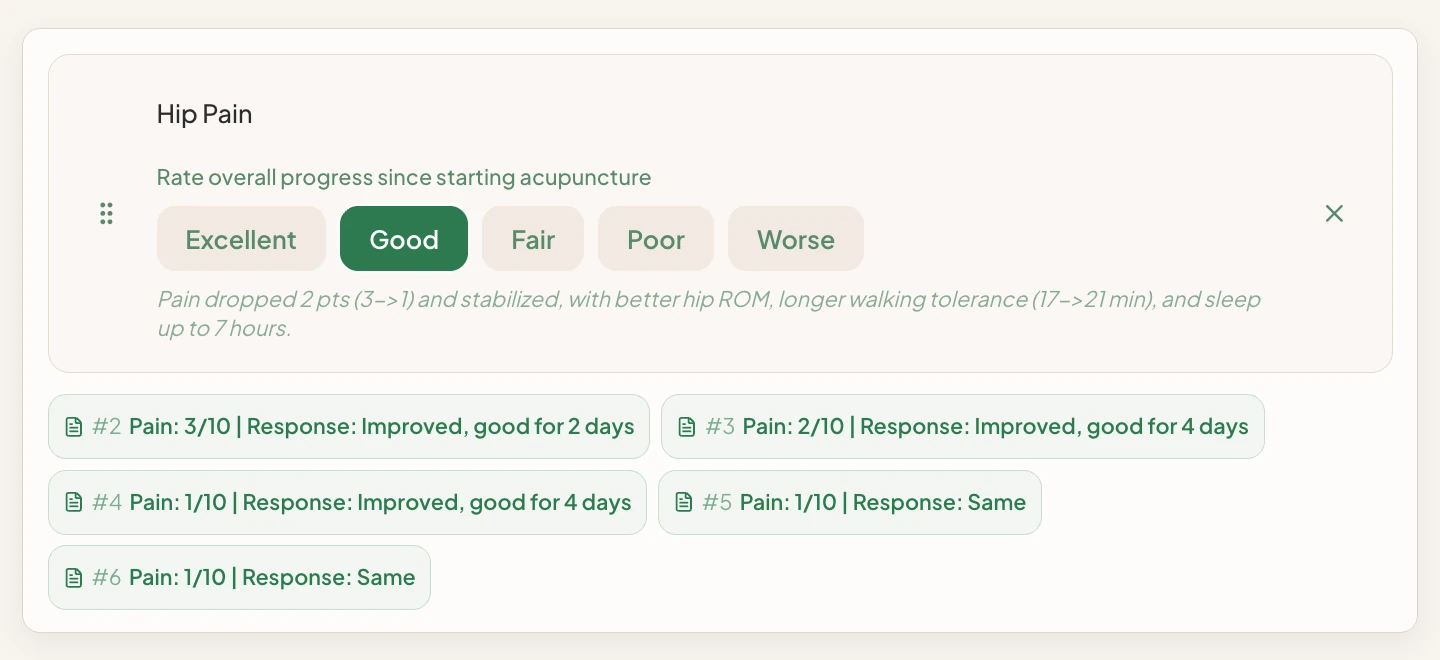
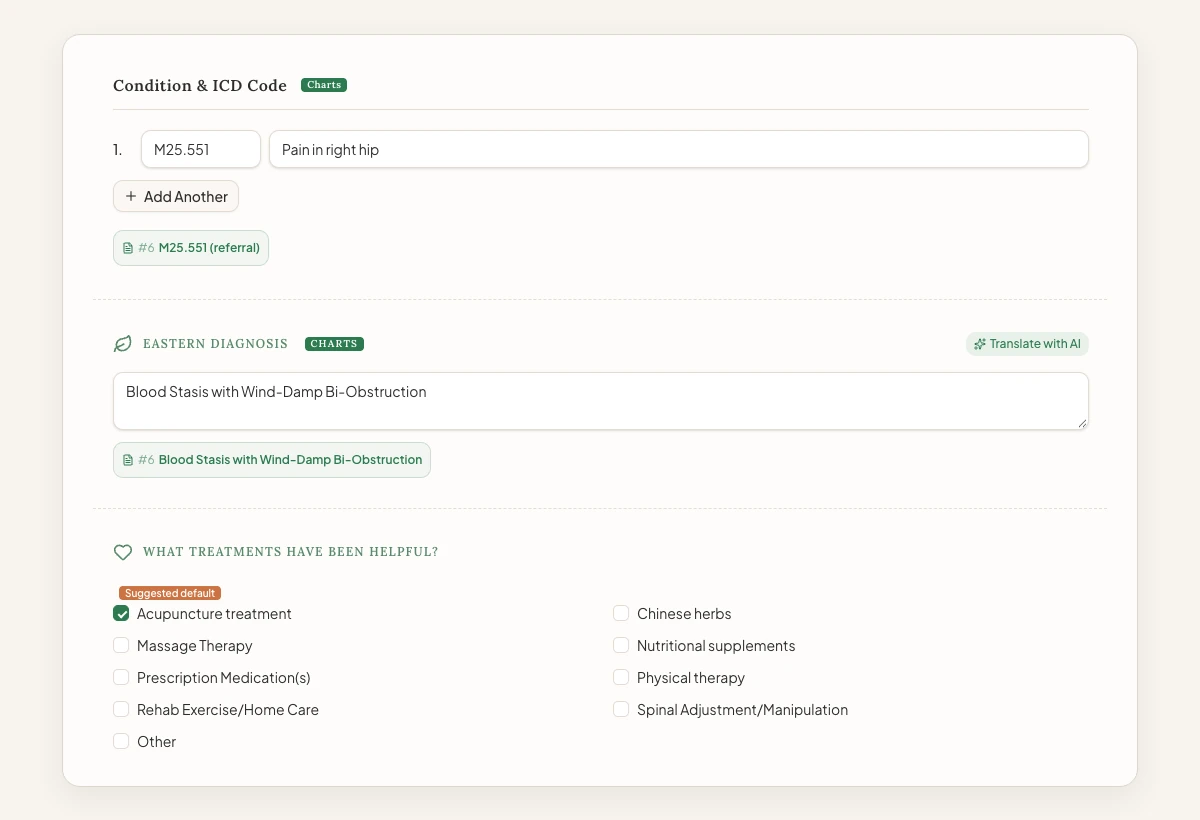
Prefilled and AI-drafted answers show evidence chips that cite the visits each value came from. A chip opens that chart so you can check the answer against its source, and it disappears once you edit the answer. Not every answer has a chip: none is shown when nothing on the chart shows the value.
Copied and computed fields
- ICD codes and the Eastern Diagnosis, the latest chart's TCM diagnosis, are copied from the charts.
- The Helpful treatments answer is fixed: AI never changes it, and it carries no chip. Its value is always exactly Acupuncture Treatment.
- Pain-medication changes are computed by comparing medication lists across the selected visits.
- Past-week average and worst pain stay blank for you to enter from the patient's answers.
Completing and locking the report
You can save an MNR as a draft at any time. You can complete it only once the patient has a later finalized visit to serve as the signature visit. Completing it locks the report. Later changes need a formal amendment with a reason of at least 10 characters.
Which codes does Dx-Chart put on a chart?
CPT codes are filled in by app logic from the visit type and the treatments you select, not by AI.
- Initial visits and revisits use 99202.
- Follow-ups use 99212, and the API rejects a chart that carries both.
- Standard acupuncture uses 97810/97811.
- Electro-acupuncture uses 97813/97814.
ICD-10 codes are checked against the official ICD-10-CM code set for the visit's date of service. AI code suggestions that are not in the set or not billable are discarded before you see them. The chart's ICD codes are checked again at finalization.
What happens when you sign a chart in Dx-Chart?
Until you sign, you can edit a chart freely. Your signature locks it right away, with no grace period.
After that, every change is a formal amendment. You give a reason of at least 10 characters and an attestation. The amendment records each changed field with its previous and new values.
The API checks that the name and license number on your account match the chart's acupuncturist details before it accepts your signature. Each signature is stored with SHA-256 hashes of the signature image and of a chart snapshot.
Charting in Korean or Chinese
Select Korean or Simplified Chinese and chart labels show the English term with the Korean or Chinese term alongside in parentheses. The stored values stay English.
Many free-text fields have an Improve with AI button. It rewrites your note into clinical English that keeps your shorthand and line breaks. That works for notes typed in Korean and Chinese as well as English. Nothing is rewritten unless you click.
Signing also finalizes the chart. Leftover non-English text in a fixed set of note fields is machine-translated to English with no review step. That set includes the HPI and pain location. TCM diagnosis and herbal formula are among the fields that stay as typed.
How does Dx-Chart handle AI and patient identifiers?
You ask for an HPI draft with a button, and it is never generated on its own. Dx-Chart drafts it from the current chart plus earlier visits in the same episode of care. A new draft stays blurred until you open it to review, and every new draft needs a fresh review.
I decided early that patient names, birth dates, and contact details would never be part of an AI request, so that line is in the code, not in a policy.
AI requests are built from clinical fields only. These are never part of one:
- Patient name and date of birth
- Address and phone number
- Email and file number
Age and sex go along as clinical context. Free-text clinical notes are sent as typed, so anything you type into a note goes with it. All AI features run through Google Cloud Vertex AI, and the API is configured to send AI requests to US locations.
Security questions to ask any charting vendor
Security claims are easier to compare when every vendor answers the same questions in writing instead of on a sales call. Here is how Dx-Chart answers:
- Sign-in uses two-step verification by text-message code, and the app signs out after 90 minutes of inactivity with a warning 2 minutes before.
- Access to patient records is written to an append-only audit log. Each entry records the user and time along with the IP address and browser user agent.
- The API filters records by organization, so one clinic cannot read another clinic's records.
- A clinic admin accepts Dx-Chart's Business Associate Agreement in the app, and the acceptance is recorded.
Unified Practice's HIPAA page describes encryption and role-based permissions for its users10. Privacy is shared work. Dx-Chart sets which fields go into an AI request, while you decide what goes into each free-text note you type.
A practical next step
Send the worksheet to each vendor on your list. Include Unified Practice, and ask for written answers. Any item a vendor leaves blank or answers only in general terms is the one to raise on your next call.
I read every single support message myself.
To see the chart itself, read about Dx-Chart's acupuncture charting software.